
How to Be an Efficient Home Worker – Part Two
In Part One of this blog, we looked at what you can do to personally become more efficient as one of the legions of Australian home workers. In this part, we will look at your home office environment and how making some small changes can dramatically increase your efficiency.
Where you work has an enormous impact on how you work – on your ability to focus (and stay focused) and your overall ability to be productive. That means the design of your office, whether you work in a separate room or at the kitchen table, is of supreme importance. This is not just about Feng Shui; this is about producing results and getting things done.
According to studies on the workplace and productivity, the most significant factor in determining your ability to focus is your physical environment. In fact, it has been said that a well-designed office space can increase your productivity by about 20%. However, despite the studies and statistics, nearly half of the now 40% of us who work from home do not consider workplace design a good business investment.
So firstly, the most important aspect of your home office is its location. One of the problems that people face when they work from home full-time is that they are “always on.” Work is always one step away, so checking emails late into the night and working on projects when you ought to be taking time away from work is an easy trap to fall into. This is where a home office can really benefit you. Having a separate room that is only for work can massively help differentiate work time from family or personal time. Additionally, if your line of work requires frequent conference calls and video chats with clients, make sure it is in an area that will not have distracting noises in the background (i.e., do not set it up in the same room as your kid’s playroom!). Pick the location of your office wisely. With that being said, not all of us have the luxury of a completely spare room to convert into an office, and so the kitchen table or even a local coffee shop is sometimes the only viable option. If that is the case, invest in a good pair of noise-cancelling headphones. Phone calls have to be made, of course, but try and keep your contact with staff and clients via the written word as much as possible.
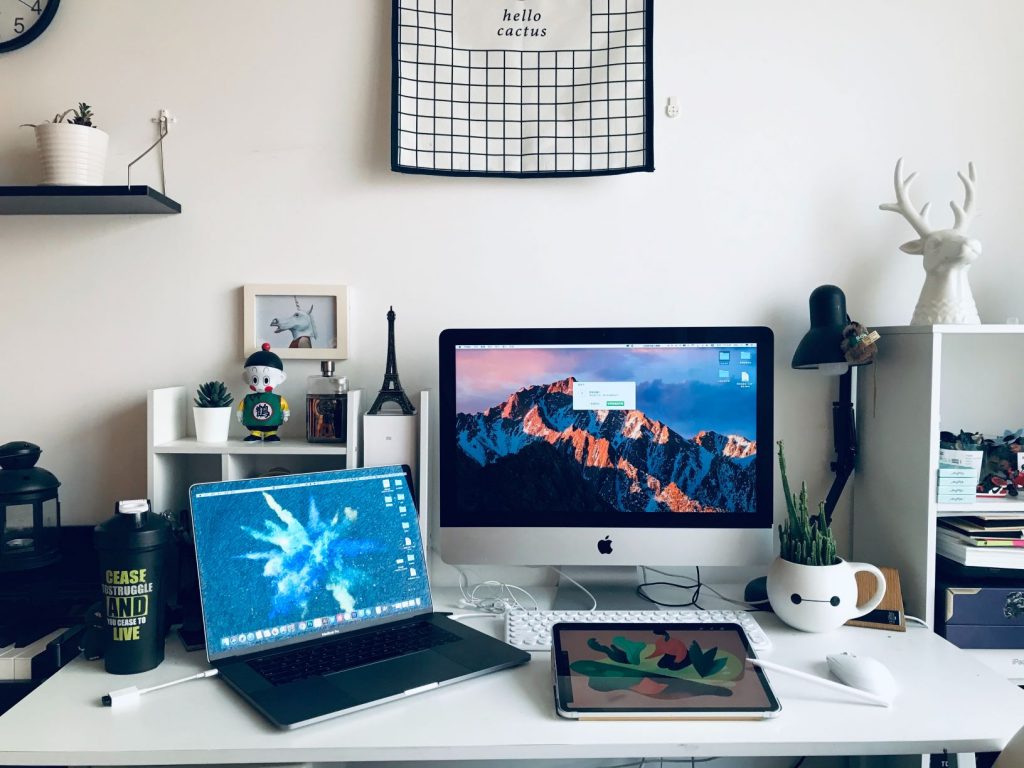
To be truly comfortable when you are working, consider the important features of your workspace.
Chair – If you are looking for one place to splurge on, consider splurging on your office chair. When you are sitting in a chair eight (or more) hours a day, five days a week, it only makes sense to spend more money for added comfort. Office Works have a terrific selection to suit every pocket, and you can try before you buy!
Desk – Nothing makes work more difficult or uncomfortable than a small desk. Make sure you choose a desk that has plenty of surface space. Yes, we are moving more and more towards an online and paperless setup, but between your monitor, laptop, tablet, phone, coffee mug, binders, and file folders, space becomes cramped quickly. And with no one to tell you to keep it tidy, it can quickly become completely overrun. Refer to our tip about tidying up your virtual and actual desktop at the end of each day – you will thank yourself in the morning.
Storage – Storage is something we take for granted until we need more of it. Having adequate drawers, shelves, and cabinets for your supplies is essential to keeping everything organised and accessible.
Besides furniture, make sure you have adequate office supplies – especially a good printer/scanner/copier combo and the peripherals to run it. The last thing you want to do when you are trying to meet deadlines is waste time searching for paper or toner ink.
Lighting is one of the most important factors in staying focused and feeling inspired, yet it is one of the most overlooked and least invested in. Bad lighting can cause fatigue, eyestrain, headaches and overall irritability. Dark spaces can actually produce depression. Open the windows and doors and let natural light in. Using lamps in a variety of areas for cloudy days or when it is dark.
Finally, bring nature into the workspace. We are, after all, biological creatures, first and foremost. So, we are deeply affected by our access to (or lack of) the natural world. It is important for our psychological and physiological functioning, which directly affects our ability to be productive. Keep the blinds open and, if you can, let in fresh air. If you cannot see anything natural out of your window, keep pictures of the natural world as your screensaver and/or desktop wallpaper (yes, really). Take walks. Or just step outside and take a short walk around the garden. Put plants in your office – research shows that having live plants in your office makes you more productive, happier and less stressed.
COVID has ensured that for the foreseeable future, a great many of us will be working from our homes. So, it makes sense to make you and your environment as efficient and comfortable as possible. So, use these tips to help you on your way to being more productive.


